

Healing the Land
Initiative
4Next7 understands the importance of maintaining respectful relationships with our human and non-human relatives – this includes the animals, plants, water, and the land itself.
Initiative Goals:
River Center Project - Tahlequah, OK
-
The River Center Project is a collaborative economic development effort undertaken between a private land developer and the state chartered municipal government of the City of Tahlequah.
The goal of the project is to build infrastructure on presently rural / undeveloped land in Tahlequah, OK through the implementation of Tax Increment Financing (TIF). -
The city council has passed a resolution which calls for the creation of a “River Center Project Review Committee”. City Attorney John Hammons said: “That group will review this proposal and make recommendations to the City Council on whether this TIF should or should not be created." Here is the full list of Committee members:
Jerry Cook
Amber Wooten
Jeremy Jones
Toney Pivec
Sherry Baker
Tanya Jones
Bobby “Cub" Whitewater
Casey Baker
Taylor Tannehill -
If approved, the project will utilize a (OK) state law to create a Tax Increment Financing (TIF) District, in order to finance infrastructure development costs within the project area.
To learn more details about TIF and how it applies to the River Center Project visit the TIF FAQ Section below. -
The Proposed Project / TIF District is bound by Crafton Street to the North, Bliss Avenue to the East, Downing Street to the South, and the Bertha Parker Bypass to the West.
Jurisdictionally, the Proposed Project / TIF District is located within the sovereign boundaries of the State of Oklahoma, the state chartered municipal government of the City of Tahlequah, the Cherokee Nation, and the United Keetoowah Band of Cherokee Indians. -
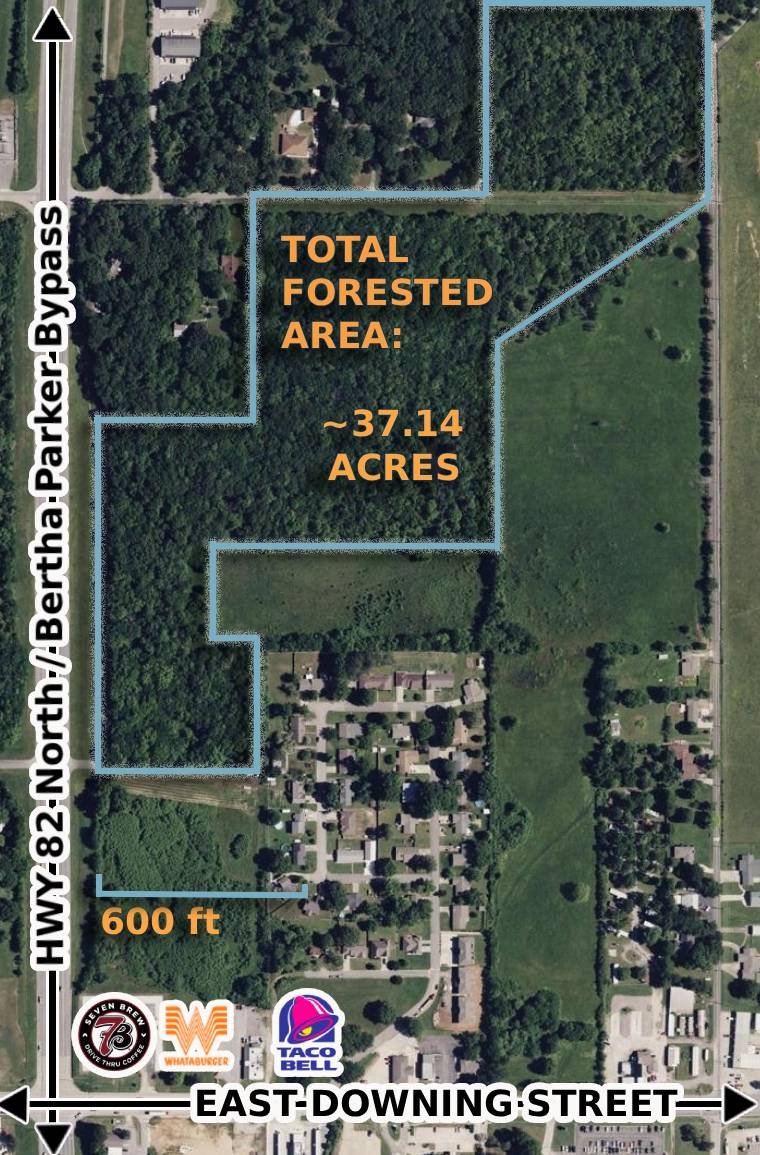
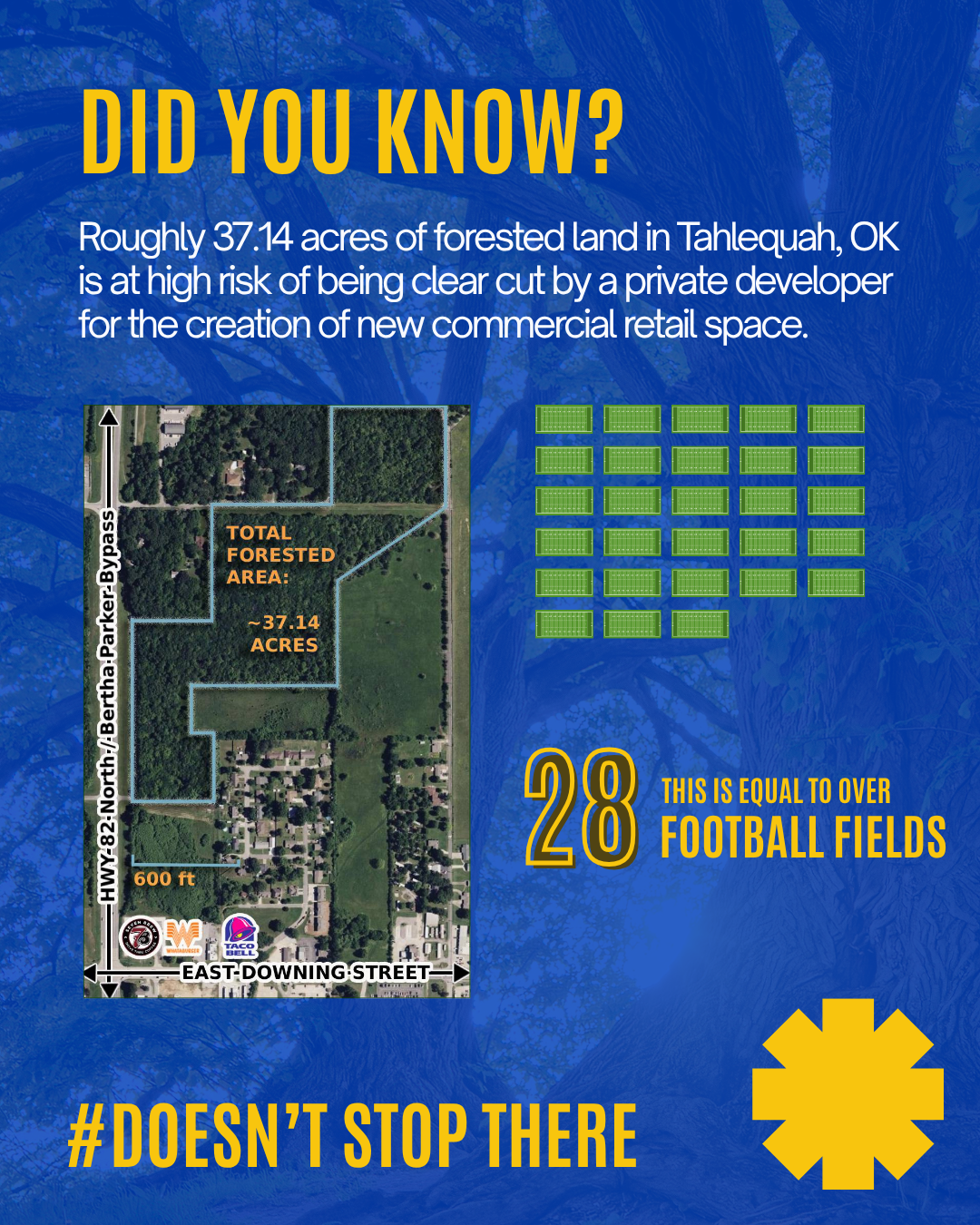
Yes — the proposed project area / TIF District contains roughly 37.14 acres of forested land. These forests presently contain both human and non-human relatives.
-
Yes, the forested land is privately owned by the developer. 4Next7 does not know a great deal about the developer. 4Next7 has not reached out to him to date to request a meeting. However, if he is interested in meeting, 4Next7 would be open to the idea.
-
![This map displays the proposed TIF District Project Area outlined in red. The map also includes property lines in yellow and the names of commercial property owners as labels. The names of all residential property owners were removed in consideration]()
Project Area Map 1
This map displays the proposed TIF District Project Area outlined in red. The map also includes property lines in yellow and the names of commercial property owners as labels. The names of all residential property owners were removed in consideration of their individual privacy.
-
![]()
Project Area Map 2
This map displays the proposed TIF District Project Area with the Forested Area outlined in turquoise. The map also includes labels for East Downing Street, HWY 82 North/ Bertha Parker Bypass, 7 Brew, Whataburger, and the New Taco Bell location as reference points.
-
![]()
Project Area Map 3
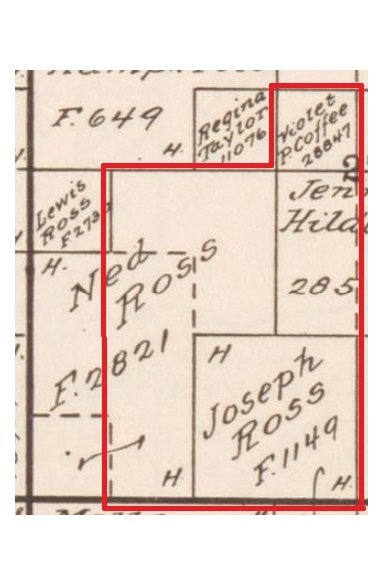
This map displays the names and boundaries of the original allotments issued by the Dawes Commission within the project area. This research was performed by 4Next7 and may contain errors. Corrections and additions are welcomed and encouraged. (Library of Congress)



Important Documents
-
![]()
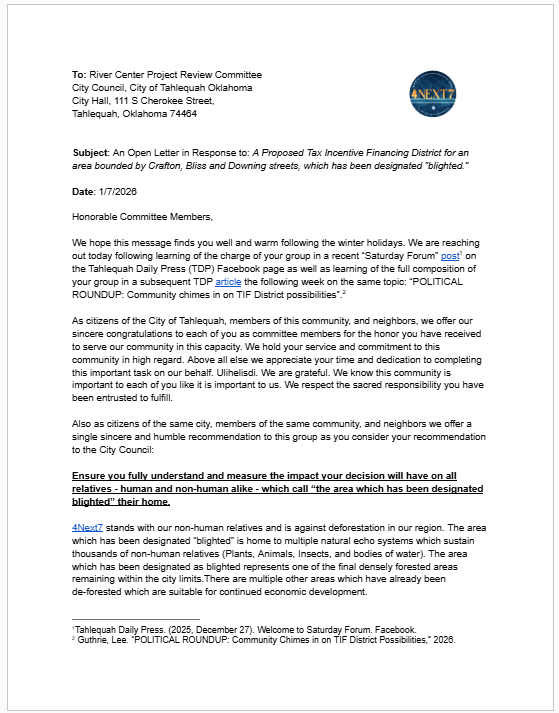
Open Letter to City Council
On January 7th, 2026 - 4Next7 Leaders Lily Drywater and Brian Barlowe hand delivered the above letter to Tahlequah City Hall and left contact information.
-
![]()
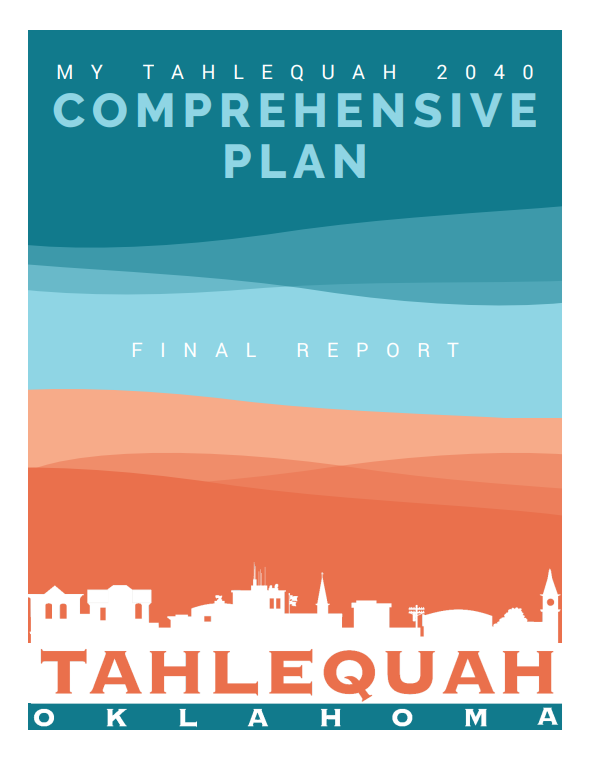
My Tahlequah 2040 Comprehensive Plan
Approved by Tahlequah City Council the purpose of the My Tahlequah 2040 Comprehensive Plan is to establish a collective vision that informs all planning decisions.
-
![]()
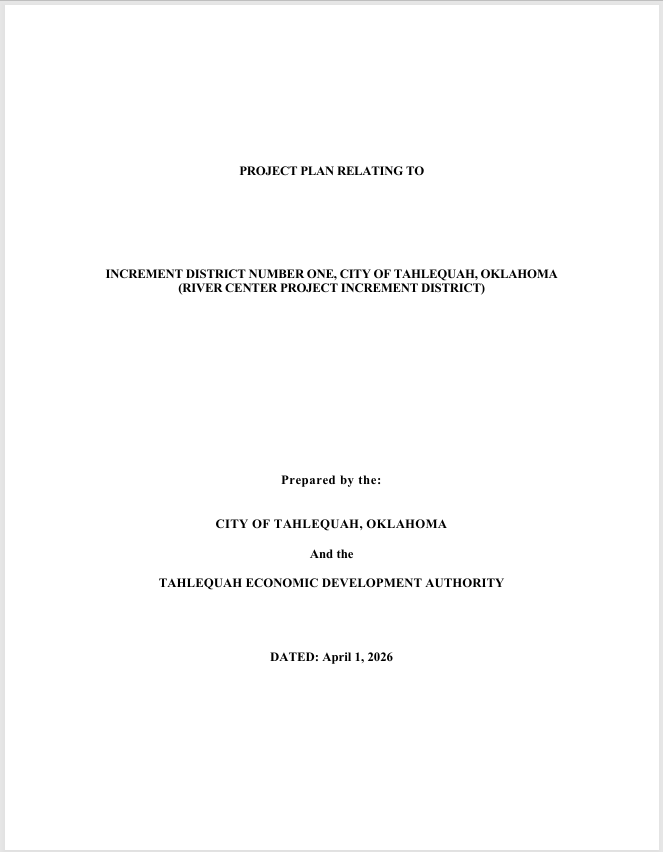
Proposed TIF Project Plan
Project Plan Relating to Increment District Number One, City of Tahlequah, Oklahoma (River Center Project Increment District) authored by the City of Tahlequah, Oklahoma and the Tahlequah Regional Development Authority.
-
![]()
The Oklahoma Forest Action Plan, 2020
The intent of this document is to provide a comprehensive and objective assessment of Oklahoma’s forest resources.
-
![]()
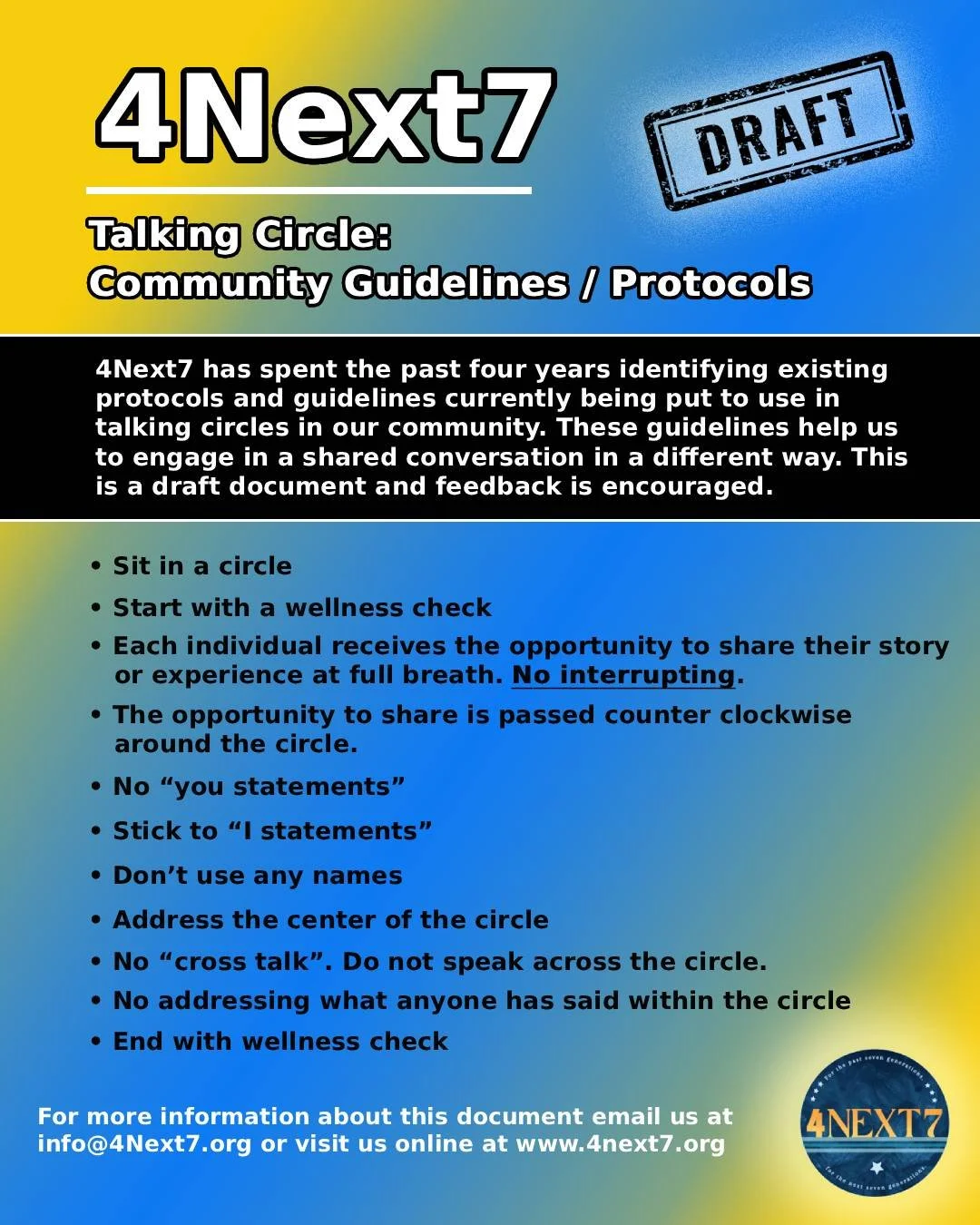
Draft Talking Circle Protocols
4Next7 has spent the past four years identifying existing protocols and guidelines currently being put to use in talking circles in our community.

Upcoming Meetings:
More Information on Tax Increment Financing (TIF)
-
The state chartered municipal government of the city of Tahlequah, OK is reviewing the creation of a Tax Increment Finance (TIF) District within the town’s city limits.
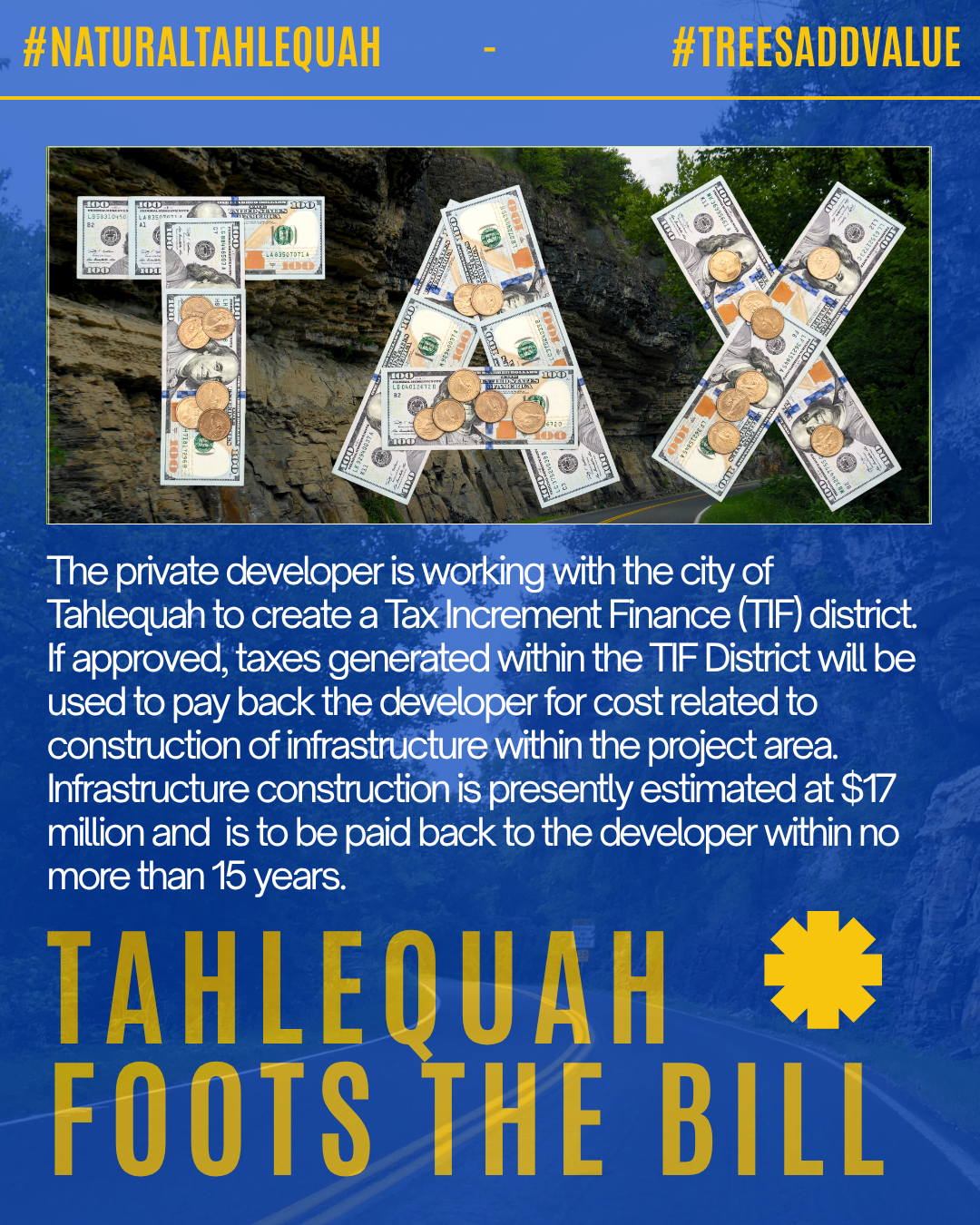
The creation of a TIF District will allow the city to leverage taxes generated within the project area to reimburse the developer for construction of infrastructure with the project area. Infrastructure includes construction of systems such as sewage, electrical, gas, stormwater retention and diversion, etc.
In order to create a TIF District, the area which is being considered must meet certain statutory standards, namely that the project is an area which has been deemed economically blighted. Under state law, all of Cherokee County is designated as a zone in need of economic opportunity and revitalization.
According to the Tahlequah Daily Press, the total project, when fully developed, would represent a construction investment of approximately $100 million. The developer, Glenn Ferguson has said, "Our estimate is it would take $16 million to put in all the infrastructure to fully develop the site.”Ferguson would put up 100% of the money to build the infrastructure, and the TIF District would allow all sales taxes and property taxes to be capped at current levels. If all the development happens as planned, the future potential sales tax and property taxes generated from this point forward would pay Ferguson back for investment in the infrastructure.
SUMMARY: Yes, if you shop within the stores constructed as a result of this policy designation, a portion of the sales tax from your purchases will be used to reimburse the developer for the investment in infrastructure. -
Tax Increment Financing (TIF) is a public tool that reallocates newly generated tax dollars for up to 25 years for supporting development or redevelopment in certain limited areas of a city, town, or county. In Oklahoma, the terms and conditions for using TIF are provided in the Local Development Act (62 O.S. §§850-869), enacted by the State in 1992 and has been amended several times. Tax Increment Financing is used to help generate private development projects, through the funding by tax dollars, for public improvements and other eligible project costs.
-
Reinvestment Area:
an area requiring public improvements in order to reverse economic stagnation or decline,
to serve as a catalyst for retaining or expanding employment,
to attract major investment in the area,
to preserve or enhance the tax base,
where 50% or more of the structures are least 35 years old; or
an area that is blighted as defined in the Urban Renewal Act.
Historic Preservations Area:
area or structure listed in, or nominated to, the National Register of Historic Places and subject to historic preservation zoning
Enterprise Area:
An area within a state or federal enterprise zone.
-
TIF revenues may be spent only for publicly approved project costs within a specific geographic area, known as the Project Area.
The Local Development Act defines project costs to include a wide range of public expenditures including:
Cost of public works, public improvements, land acquisition, clearance, and grading
Financing, professional services, administration, interest fees
Assistance in development financing for private projects
-
Tax Increment Financing is used to help generate private development projects, through the funding by tax dollars, for public improvements and other eligible project costs.
-
The government borrows money to invest in the development, typically for incentives or public infrastructure. The loan is repaid by capturing a portion of the taxes generated by the development.
-
Once the loan is repaid, the TIF district expires and 100 percent of the tax revenues are apportioned to the taxing jurisdictions.